San Francisco: Google is betting
consumers will pay slightly more for a sleeker, more powerful version of
its Nexus 7 tablet as the Internet company escalates its rivalry with
Apple and Amazon.com in technology's key battleground - the mobile
computing market.
The fancier devices unveiled on Wednesday in San Francisco will
go on sale in the US next Tuesday in Google's online store and numerous
retailers with brick-and-mortar stores.
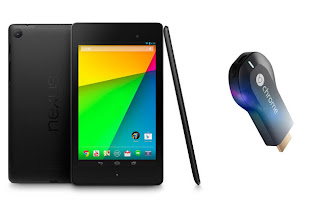
Among other things, the souped-up line of Nexus tablets will
boast a higher-definition 7-inch display screen and a processor that
promises to be nearly as twice as fast. Dual stereo speakers have been
added for richer sound, and the device's battery duration has been
extended to 10 hours for Web browsing, an increase of about an hour.
On other fronts, Google also unveiled a
gadget that will lean on its widely used Chrome Web browser and take aim
at Apple on another front - the living room.
The new device, called Chromecast, is part of the company's
attempt to make it easier for people to access Internet content on their
TVs. Chromecast is a small stick roughly the same size as a thumb drive
that can be plugged into an HDMI port on flat-panel TVs. It brings
Netflix, Google's YouTube site and other Internet content to what is
usually the biggest screen in households.
Forrester Research analyst Sarah Rotman Epps said Chromecast
could undermine Apple in the still-nascent market to plug streaming
devices into TVs, just as the Nexus tablets have siphoned some sales
away from Apple's iPad.
Google's previous products designed to connect TV sets to the
Internet haven't worked out well. The company initially tried to embed
an operating system called Google TV into sets made by TV manufacturers,
but that flopped. Last year, Google introduced an orb-like device
called the Nexus Q in hopes of delivering more Internet video to
flat-panel TVs, only to quickly pull the product from the market.
"Chromecast looks like a smart and disruptive device," Rotman
Epps said. "Maybe it took the other failures for Google to get it
right."
Google wants to have a presence on TVs because it could open up a
lucrative new channel for it to sell more ads, which bring in most of
its revenue.
In a show of its determination to make inroads on TVs, Google
started selling Chromecast for just $35 on Wednesday. That price
undercuts the most popular Internet-streaming devices made by Apple and
Roku. An Apple TV box sells for $99, while the least expensive Roku box
capable of showing high-definition video goes for $80. Roku, a company
that formed within Internet video subscription service Netflix, also
sells an Internet streaming stick similar to Chromecast for $100.
Earlier this year, Apple revealed that it has sold more than 13
million of its streaming boxes. Roku said its sales of streaming boxes
surpassed 5 million units this year.
The Chromecast device connects with smartphones, tablets and
personal computers to beam Internet connect to TVs. The Apple and Roku
streaming boxes rely on a standard remote control to select Internet
content.
As an enticement to get people to try Chromecast, Google is
offering three months of free Netflix service with a purchase of the
Internet-streaming stick. That translates to a $24 value, leaving the
cost of the device at $11 for those who would have gotten Netflix
anyway.
As for the Nexus 7, the extra firepower added to the second
generation of the tablets will come with a higher price. A model with 16
gigabytes of storage will sell for $229, a $30 per increase from the
current Nexus 7 released a year ago. That's still 30 per cent below the
$329 that Apple charges for its iPad Mini. A comparable Kindle Fire HD
tablet from Amazon.com currently sells for $199.
A 32-gigabyte version of the Nexus 7 will sell for $269, a $20 price increase.
The price hike for the Nexus 7 comes at a time when more people
have been showing a preference for less expensive tablets. Google helped
propel the trend with last year's introduction of the Nexus line,
contributing to pressure for Apple to come out with the iPad Mini as an
alternative to its top-selling tablets with a 10-inch screen.
Google is confident the Nexus 7 will still look like a great
value once consumers see how much more powerful the new models are, said
Sundar Pichai, an executive who oversees the company's Android and
Chrome software.
The iPad Mini has driven down the average selling price of
Apple's tablets, hurting the Cupertino, Calif., company's profit
margins.
Even at a lower price, the Nexus tablets haven't been as popular
as the iPad. Pichai said the Nexus products account for about 10
percent, or 7 million, of the roughly 70 million tablets now running
Android software.
In the first half of this year alone, Apple sold 34 million iPads, including full-size models.
Amazon.com doesn't disclose its sales of Kindle Fires, which run
on a modified version of Android. The research firm IDC estimates about
1.8 million Kindle Fires were sold during the first three months of this
year.
The Nexus 7 will be the first device to get the 4.3 version of
its Android software. It's a relatively minor upgrade from the "Jelly
Bean" flavour of Android. Google still hasn't said when it will release a
more comprehensive Android overhaul, currently known as "Key Lime Pie."
As with the original line of Nexus 7s, the new devices are being made by AsusTek Computer, working from Google's design.
Google is still tinkering with a new line of Nexus tablets with
10-inch display screens. The Mountain View, California, company also
hasn't updated its Nexus 4 phones, though it worked with phone makers to
release variants of Samsung's Galaxy S4 and HTC's One this summer. The
variants run a pure version of Android, without the customizations added
by the phone makers.


