Showing posts with label Microsoft. Show all posts

Thursday, September 5, 2013

Asha is the new hope for Microsoft

Microsoft-Nokia may never reach the market share highs that Nokia saw in India-it was 56% in 2008-but the merged entity stands a good chance of arresting the fall (the share is now down to 27%) and making gains in the mid and upper segments of the mobile phone market.

Most analysts don't think Microsoft will bother about the low-end of the feature phone segment, where margins are very low and local players like Micromax and Karbonn have proved too competitive for Nokia. This market remains big in India, and so long as it remains big and Microsoft does not play significantly in it, the company's share in the overall market will stay low.

The big opportunity that Microsoft perhaps sees is in the mid- and upper-end, where it has the Asha and the Windows-based Lumia brands. Manasi Yadav, senior market analyst with research firm IDC India, believes Microsoft will bring greater focus to the mid segment in the short run. "Access to Nokia's patents and OS will help it to create powerful devices in the market. Going forward, we will see more launches in the sub-Rs 10,000 market that will lift volumes. Nokia has strong brand equity in feature phones and since Microsoft has inherited strong legacy from Nokia, they will look at new launches in that price point," she said. IDC categorizes Asha phones, priced at Rs 4,000-6,000, as feature phones, though some call them low-end smartphones.

Soma Sundaram, founder of mobile payments platform iKaaz, said Asha was a huge win for Microsoft, "From a growth with profitability perspective, the Asha and higher-end smartphone segments are what Microsoft will likely focus on."

Yadav thinks Microsoft will take a longer time to build its smartphone strategy because Lumia is still a nascent platform compared to Android.

Anshul Gupta, principal research analyst in Gartner, said since the Nokia deal puts Microsoft closer to the customer-as it now controls both hardware and software-they would be in a better position to understand what the market wants. "This deal is good for the Windows ecosystem and MS should be able to manage device upgrades easily," he said. But Sridhar Pai, CEO of telecom research company Tonse Telecom, said Microsoft would find the going tough. "They are late entrants into a market dominated by Android phones. They have a set of adaptive issues and they have to execute their strategy faster to accelerate their capabilities," he said.

Wednesday, September 4, 2013

Microsoft CEO‘s email to staff on Nokia acquisition

Microsoft Corp has announced that it is buying Nokia's mobile phone business for 5.44 billion euros. Below is Microsoft CEO Steve Ballmer's letter to employees on the acquisition.

From: Steve Ballmer
To: MS FTEs
Date: Sep. 2, 8:00 PM PDT (Sep. 3, 6:00 AM EET)
Subject: Accelerating Growth

We announced some exciting news today: We have entered into an agreement to purchase Nokia's Devices & Services business, which includes their smartphone and mobile phone businesses, their award-winning design team, manufacturing and assembly facilities around the world, and teams devoted to operations, sales, marketing and support.

For Microsoft, this is a bold step into the future and the next big phase of the transformation we announced on July 11.

We are very excited about the proposal to bring the best mobile device efforts of Microsoft and Nokia together. Our Windows Phone partnership over the past two and half years has yielded incredible work - the stunning Lumia 1020 is a great example. Our partnership has also yielded incredible growth. In fact, Nokia Windows Phones are the fastest-growing phones in the smartphone market.

Now is the time to build on this momentum and accelerate our share and profits in phones. Clearly, greater success with phones will strengthen the overall opportunity for us and our partners to deliver on our strategy to create a family of devices and services for individuals and businesses that empower people around the globe at home, at work and on the go, for the activities they value most.

We have laid out Microsoft's strategic rationale for this transaction in a presentation that I encourage you to read.

This is a smart acquisition for Microsoft, and a good deal for both companies. We are receiving incredible talent, technology and IP. We've all seen the amazing work that Nokia and Microsoft have done together.

Given our long partnership with Nokia and the many key Nokia leaders that are joining Microsoft, we expect a smooth transition and great execution.

As is always the case with an acquisition, the first priority is to keep driving through close, which we expect in the first quarter of 2014, following approval by Nokia's shareholders, regulatory approvals, and other closing conditions.

But I also know people will have some questions about what happens post-close. While details aren't final, here is what we know, and how we're generally approaching integration:

1. Stephen Elop will be coming back to Microsoft, and he will lead an expanded Devices team, which includes all of our current Devices and Studios work and most of the teams coming over from Nokia, reporting to me.

2. Julie Larson-Green will continue to run the Devices and Studios team, and will be focused on the big launches this fall including Xbox One and our Surface enhancements. Julie will be joining Stephen's team once the acquisition closes, and will work with him to shape the new organization.

3. As part of the acquisition, a number of key engineering leaders will be joining Microsoft from Nokia, reporting to Stephen in his new capacity: * Jo Harlow, who will continue to lead the Smart Devices team
* Timo Toikkanen, who will continue to lead the Mobile Phones team
* Stefan Pannenbecker, who will lead Design
* Juha Putkiranta, who will lead the integration effort on Nokia's behalf

4. Regarding the sales team, we plan to keep the Nokia field team, led by Chris Weber, intact and as the nexus of the devices sales effort, so that we can continue to build sales momentum. After the deal closes, Chris and his team will be placed under Kevin Turner. We will develop a single integrated team that is selling to operators, and there may be other integration opportunities that we can pursue. Kevin will work with Chris Weber and Chris Capossela to make those plans.

5. Our operating system team under Terry Myerson will continue unchanged, with a mission of supporting both first-party and third-party hardware innovation. We are committed to working with partners, helping them build great products and great businesses on our platform, and we believe this deal will increase our partner value proposition over time. The established rhythms and ways of working between Terry and his team and the incoming Nokia team will serve us well to ensure that we do not disrupt our building momentum.

6. We are planning to integrate all global marketing under Tami Reller and Mark Penn. It is very important that we pursue a unified brand and advertising strategy as soon as possible.

7. Finance, Legal, HR, Communications, DX / Evangelism, Customer Care and Business Development will integrate functionally at Microsoft. Sourcing, customer logistics and supply chain will be part of Stephen's Devices organization. ICM / IT will also integrate functionally for traditional IT roles. We will need to work through the implications for factory systems given the differing manufacturing processes and systems at both Nokia and Microsoft.

8. We plan to pursue a single set of supporting services for our devices, and we will figure out how to combine the great Nokia efforts into our Microsoft services as we go through the integration process.

9. There are no significant plans to shift where work is done in the world as we integrate, so we expect the Nokia teams to stay largely in place, geographically.

10. Tom Gibbons will lead the integration work for Microsoft. While today's announcement is big news, we have to stay heavily focused on running the current business. We have a huge fall and holiday season ahead of us, so we need to execute flawlessly and continue to drive our business forward. I have no doubt we will.

Steve Text courtesy: microsoft.com

Microsoft buys Nokia for $7.2 billion

Microsoft's acquisition of handset major Nokia's phone division has drawn a lot of interest in the tech and business world. Will beleaguered Nokia be better able to succeed at what it could not as a standalone player? Will Microsoft be able to rewrite its smartphone story now & compete better with Apple and Google? These are the questions only time can answer. But the two are definitely expected to derive better synergies with the merger.
Read More »

Wednesday, June 20, 2012

Windows8 brings Cloud Computing to all

Interestingly, Microsoft have listed three distinct categories of how people use cloud computing for personal use.
  1. File Clouds
  2. Device Clouds
  3. Application Clouds
File Clouds provide cloud based traditional file storage that give users access from anywhere and examples include Microsoft’s own SkyDrive as well as services such as DropBox.
Device Clouds allow content to be purchased and shared across multiple devices in a transparent way. These devices maybe TV’s, mobile devices and work without the users having to be concerned where the content is stored. The most obvious example of this is Apple’s iCloud.
Application Clouds Hosted in the cloud, these applications allow anywhere access as well as improved document sharing and collaboration. No client software installation and a pay per use model means that these applications are attractive to individuals. Examples include Google Apps, Office365 as well as services such as Spotify.Let us see how microsoft incorpates this features in windows8.


1. A fully fledged operating system with cloud computing
Numerous efforts in the arena of cloud computing are focused on browser based cloud computing. Windows 8 is different. It seeks to provide all the features you need in an operating system while enabling cloud computing. Windows 8 will get installed on your PC, tablet or your phone and offer cloud computing on all these devices along with all that an OS brings.

2. Access to applications over the web
Installation, configuration and troubleshooting of applications will not be the responsibility of the user. In addition, you will not have to invest in buying apps that you do not need over the long term. Access applications when you need them without having to go through the hassle of installation, configuration or maintenance.

3. Freedom from need for synchronization of data on devices
This is akin to the various applications you use over the web wherein you store data that you can access anytime from any of the devices through which internet access is possible, whether it is your laptop, desktop PC, a tablet or a mobile phone.

4. Retention of device storage space
This is a definite advantage over Google’s Chromebook which allows only cloud based storage. The way Chromebook goes about providing cloud computing is not likely to go down well with everyone and may still see people getting apprehensive. Windows 8 strikes a balance with facility for storage on the device as well as in the cloud. This will certainly find favor with people.

5. Ease of scaling of resources
The high cost of maintenance, resource expansion and computing infrastructure will become a thing of the past with Windows 8. Sharing of resources and use of resources as a service will enable a reduction in operational costs. If you are a small business owner, you will benefit immensely from cloud computing services through Windows 8. Windows Azure platform is likely to come in the picture here. Your storage needs and application requirements as your business grows need not be a reason to worry. Scale up the resources seamlessly with cloud computing. Use the applications without investing heavily in buying them and worrying about the maintenance issues. Windows 8 will make this possible through cluster support.
The advantages of cloud computing presented it as a favorable alternative in the world of computing. As and when it makes its presence felt in the general desktop computing domain, the cost of using computing resources will go down significantly. In addition, syncing of data on different devices will become a thing of past. All eyes are now on the launch of Windows 8.


Tuesday, June 19, 2012

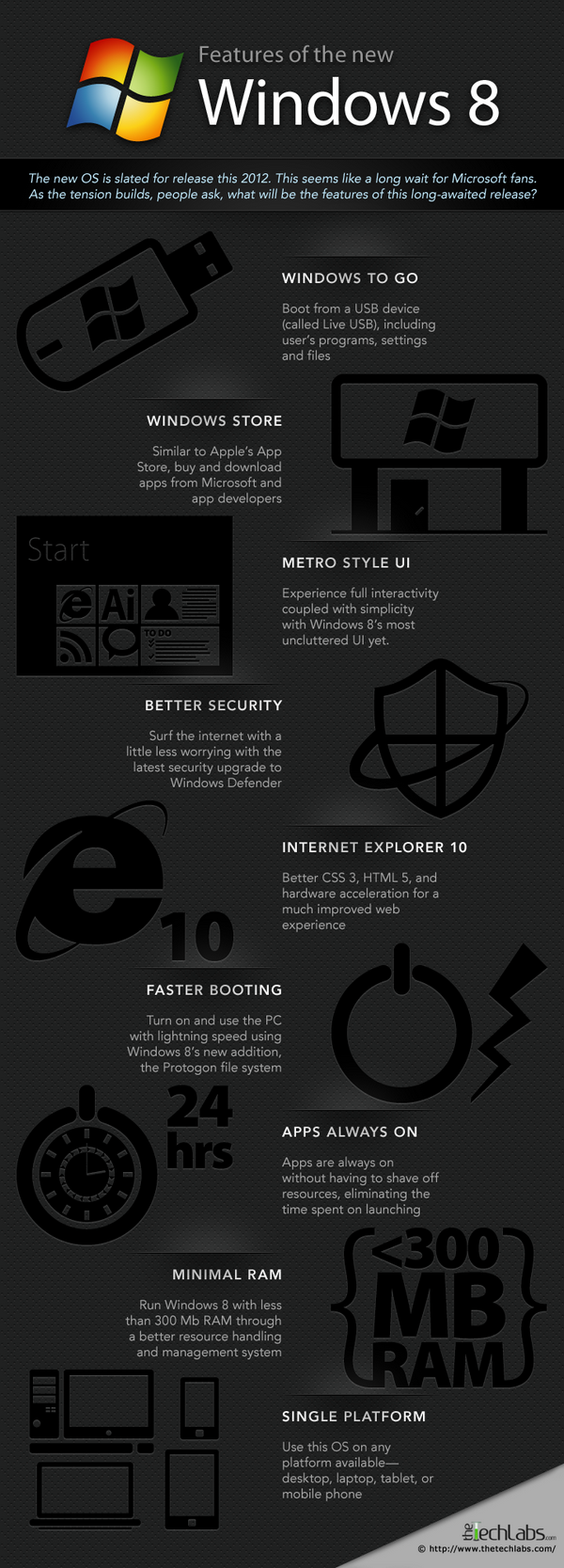
Windows 8 Features

In this blog, I can show the amazing features of windows. If you want to try windows8, It is available for free download, and comes in three different packages:
  • (1) 64-bit version – Only the OS
  • (2) 32-bit version – Only the OS
  • (3) 64-bit version with developer tools

    Support for both x86 PCs and ARM tablets

    Works on both ARM based tablets and traditional x86 (as well as x32 and x64) PCs based on ARM processors from Intel and AMD.

    Windows To Go

    The “Windows To Go” seems to be an exciting feature that basically allows Windows 8 to boot from a USB device (called as Live USB), including user’s programs, settings and files. The feature is designed to work with both USB 2.0 and USB 3.0, and on both legacy NIOS and UDFI firmware. 
    “Windows To Go is a new feature in Windows 8 that enables enterprise administrators to create USB drives containing complete, managed Windows images that users can use to boot and run Windows on any Windows 7 or Windows 8 capable computer. Windows To Go makes it possible for employees to use a managed device whether they work from home, a client office or in a free seating environment. This session will discuss Windows To Go, its hardware requirements and building compatible and complementary software.”
    Another interesting thing about this feature is that, if the USB drive is removed, Windows will automatically freeze, but will continue to operate if the USB drive is inserted back in the next 60 seconds after removal.

    Windows Store

    To compete with Apple, Windows has confirmed the introduction of a Windows Store, similar to Mac App Store, which allows users to browse through Windows applications, while developers can publish their Metro-style apps on Windows 8 devices.
     Microsoft revealed that the Windows App Store will be the only place where users can access the Metro-styled apps.

    Windows 8 User Interface

     The UI is designed to provide a fluid and intuitive interaction and navigation with touch, or a mouse and keyboard.
    Julie Larson-Green, Corporate Vice President, Windows who stated: “Everything that’s great about Windows 7, is better in Windows 8,” gave a quick hands on look at the Windows 8 user-interface. Here are some of the screenshots she released:
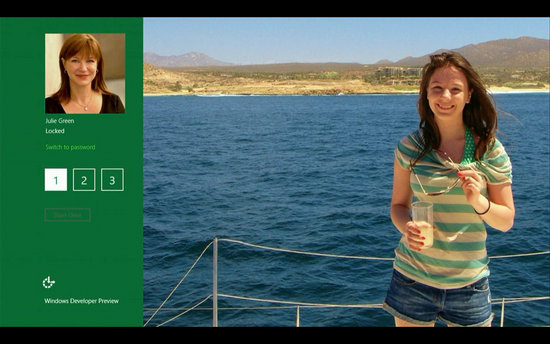
    Windows Logon Screen – Unlike the traditional way of entering a password to unlock the screen, Windows 8 can be unlocked by just tapping on the right areas of the screen.
    Windows Logon Screen

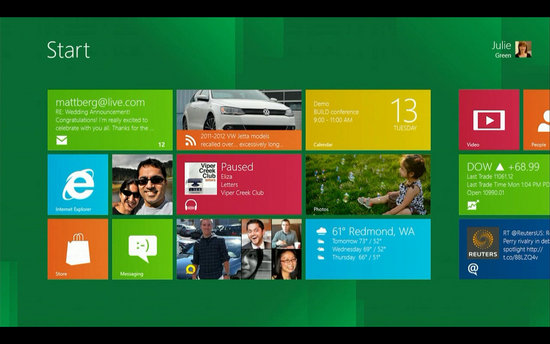
     Windows 8 Start Screen – The Start screen is yet another impressive UI. The screen basically groups all your applications together, which you can easily drag and drop, or add new things.
    Windows8 Start Screen

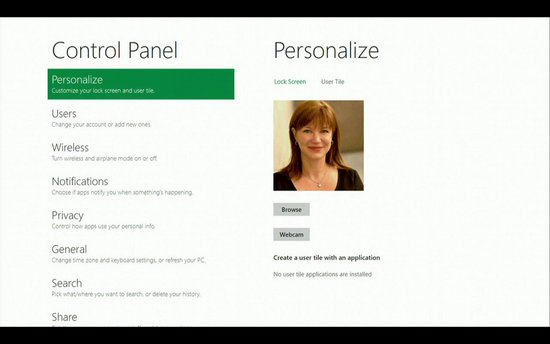
     Control Panel
    Windows8 Controlpanel
     Playing Videos in Windows 8
    Playing Videos in Windows8
    Windows 8 Task Manager

    Windows 8 Minimum System Requirements

    It is reported that Windows 8 is expected to have the same system requirements as Windows 7, and will run on existing machines that run Windows 7. Here are the following minimum system requirements to run Windows 8:
    Processor: 1GHz or faster 32-bit or 64-bit processor
    RAM: 1GB (32-bit) or 2GB (64-bit)
    HD Space: 16GB for 32-bit (or 20GB for 64-bit)